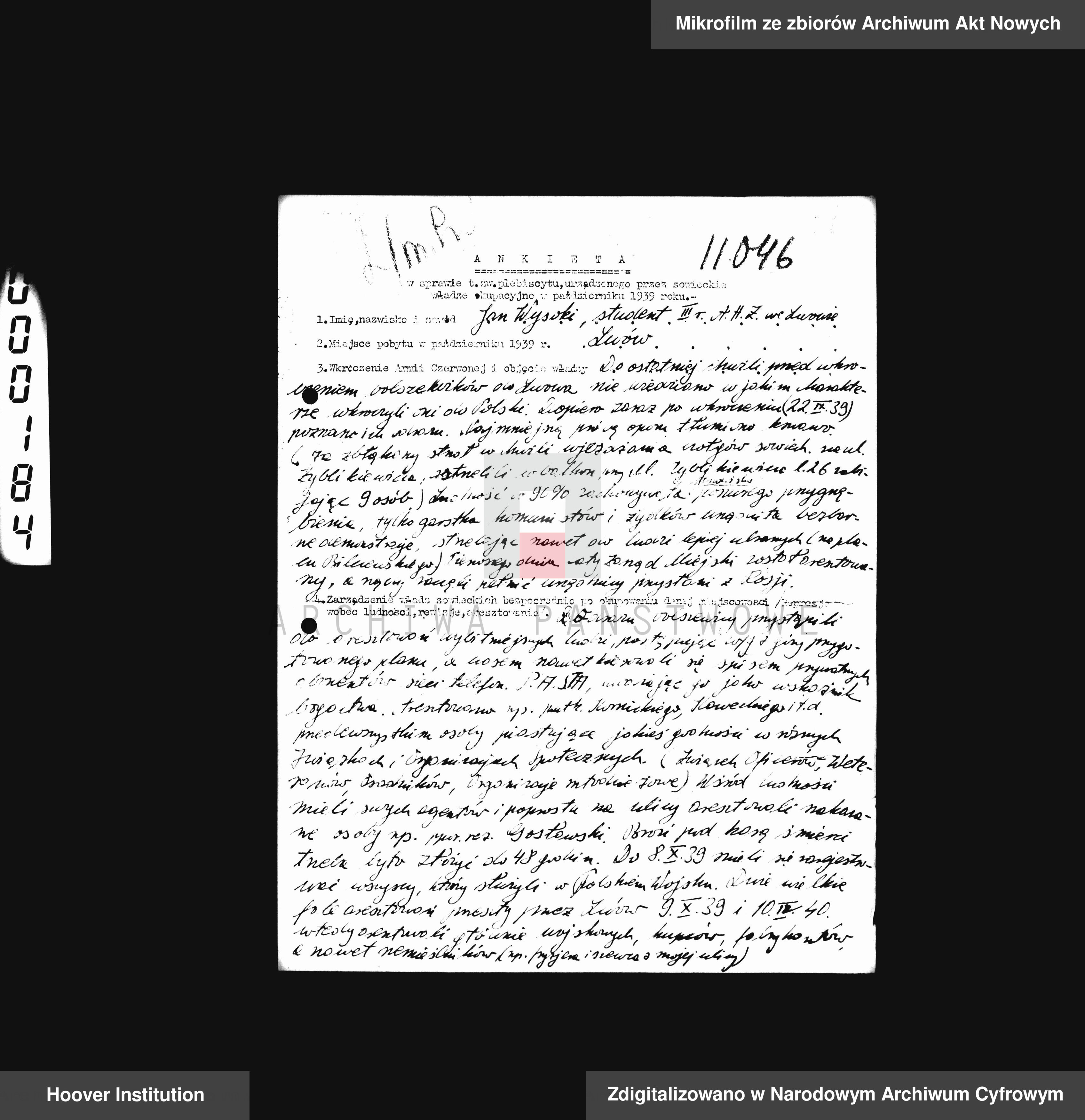

As today is the 85th anniversary of the soviet invasion of Poland, I thought I would share with you some of my father’s thoughts on those awful events, before he and his family were arrested and deported to Siberia as enemies of the people.
Below is a translation, as far as I could, of my father’s words. He was born in 1919, so just 20 when the war broke out and his life changed for ever.
Below that is a transcript in Polish – I am not entirely sure of its accuracy, so if you have any ideas, please let me know.
In any case, do please let me know if you read this.
Questionnaire on the so-called plebiscite organised by the Soviet occupation authorities in October 1939.
1 Name, surname and occupation.
Jan Wysoki, 3rd year student at the Academy of Foreign Trade in Lwów.
2 Place of residence in October 1939.
Lwów.
3 The invasion of the Red Army and the seizure of power.
Until the very last moment before the Bolsheviks entered Lwów, it was not known in what capacity they were entering Poland; only after their entry on 22 September 1939 did it become immediately clear. The slightest attempt at resistance was bloodily crushed. (After a stray shot just at the moment of the Soviet tanks’ entry on 26 Zyblikiewicza Street, 9 people were killed).
90 % of the population maintained a position of gloomy despondency; only a handful of Communists and Jews staged a low-level demonstration. They even shot at better-dressed people in Bilczewski Square. On the first day, the entire city council was arrested. At night, officials sent from Russia began to take office.
4 Orders issued by the Soviet authorities immediately after the occupation of a town. Repression of the population; searches; arrests.
Immediately after the incursion the Bolsheviks began to arrest prominent people according to a prearranged plan, sometimes even guided by the directory of private subscribers to the PASTA telephone network, which they considered to be an indicator of wealth. For examples Colonels Kórnicki, Kowalski, etc. were arrested. Above all, they arrested people who had held some kind of office in various societies and social organisations. (Officers’ Union, Veterans’ Union, Settlers’ Union, Youth Organisations.)
The soviets had their agents among the population, and they simply arrested listed people on the street, e.g .the reservist 2nd Lt. Gosłowski. Weapons had to be handed in within 48 hours, on penalty of death. All those who had served in the Polish army had to register by 8 October 39.
On 9 October 39 and 10 April 40, large waves of arrests rolled through Lwów. At that time, it was mainly soldiers, merchants, factory owners and even craftsmen who were arrested, eg g r example, a laundress and a shoemaker from my street.
5 Pre-election agitation; methods of agitation; forced meetings and rallies; drawing up of electoral lists.
Each building had its own agitator who, with various threats, forced the inhabitants to attend these election meetings; these were held in Russian, rarely in Ukrainian and never in Polish. The agitator would confiscate the tenants’ book from the caretaker and would find out each tenant’s occupation. If one of the inhabitants wasn’t at the pre-election meeting, he would say in Russian: ‘Why wasn’t the wife of that officer or clerk at the meeting? That cannot be – you have to come to their flat and see how they live – maybe they don’t like Soviet power?’. If the person in question had not yet arrived, they would search his or her home.
6 The organisation of the elections; the composition of the election commission and how and which candidates were put forward to the so-called Assembly of Western Ukraine and Western Belarus.
The electoral commission consisted of 70% Russians who did not know the language or the local conditions. Our Jews and Ukrainians made up 15%. The candidates were completely unknown to the local population and were imposed in advance by the Soviets.
7 How the election took place.
Voting took place under the komivoy, i.e. the local communist organisation (previously defined as polyn), where under the ostensible command of an agitator, they went to the polling station. And there, under the eyes of the guards, everyone was given a voting slip, then their names were ticked off the electoral register and everyone was escorted to the ballot box. There were partitions, but they were unnecessary, as there was only one candidate on the slip. If anyone managed to break away from the escort and get behind the curtain before the ballot paper was put in, a Russian woman came up to them and asked for their name, which was then written down. After the voting, an agitator came to my apartment with a list and asked me why I had gone behind the curtain. This is what ‘forced voting’ looked like.
Transcript in Polish
Ankieta w sprawie tak zw. plebiscytu urządzonego przez sowieckie władze okupacyjne w październiku 1939 roku.
1 Imię, nazwisko i zawód. Jan Wysoki, student III r. Akademia Handlu Zagranicznego we Lwowie.
2 Miejsce pobytu w październiku 1939 roku. Lwów.
3 Wkroczenie Armii Czerwonej i objęcia władzy.
Do ostatniej chwili przed wkroczeniem bolszewików do Lwowa nie wiedziano w jakim charakterze wkroczyli oni do Polski; dopiero zaraz po wkroczeniu 22/9/39 poznano ich od razu. Najmniejszą próbę oporu tłumiono krwawo. (Za zbłąkany strzał w chwili wjeżdżania czołgów sowieckich. na ul Zyblikiewicza 26 zabijając 9 osób.) Ludność w 90 procentach zachowywała stanowisko ponurego przygnębienia, tylko garstka komunistów i żydków urządziła bez borne demonstracje. Strzelając nawet do ludzi lepiej ubranych na placu Bilczewskiego. Pierwszego dnia cały zarząd miejski został aresztowany. A nocą zaczęli pełnić urzędnicy przysłani z Rosji.
4 Zarządzenia władz sowieckich bezpośrednio po okupowaniu danej miejscowości. Represje wobec ludności; rewizje; aresztowania.
Od razu Bolszewicy przystąpili do aresztowań wybitniejszych ludzi, postępując według z góry przygotowanego planu a czasem nawet kierowali się spisem prywatnych abonentów sieci telefonu PASTAuważając je jako wskaźnik bogactwa. Aresztowano np. pułkownika Kórnickiego, Kowalskiego, itd. Przede wszystkim osoby piastujące jakieś obowiązki w różnych związkach i organizacjach społecznych. (Związek oficerów, Weteranów, Osadników, Organizacje młodzieżowe.) Wśród ludności mieli swych agentów i po prostu na ulicy aresztowali nakazane osoby np. Podporucznika rez. Gosłowski. Broń pod karą śmierci trzeba było złożyć do 48 godzin. Do ósmego października 39 mieli się zarejestrować wszyscy, którzy służyli w polskim wojsku. Duże wielkie fale aresztowań przeszły przez Lwów dziewiątego października 39 i 10 kwietnia 40. Wtedy aresztowano głównie wojskowych, kupców, fabrykantów a nawet rzemieślników np. pralnie i szewca z mojej ulicy.
5 Agitacja przedwyborcza; sposoby agitacji; przymusowe zebrania i mitingi; sporządzenie spisów wyborów.
Każda kamienica miała swego agitatora, który pod różnymi groźbami przymuszał lokatorów do chodzenie na te zebrania wyborcze, odbywające się w języku rosyjskim, rzadziej ukraińskim a nigdy polskim. Agitator zajmował od stróży kamienicy książkę lokatorów i z niej wiedział o zawodzie każdego lokatora. Jak ktoś z lokatorów nie był na zebraniu przedwyborczym to mówił po rosyjsku: „Dlaczego ta żona oficera czy urzędnika nie była na zebraniu. Nie wolno – trzeba przyjść do niej do mieszkania i zobaczyć, jak oni żyją – Może im się sowiecka władza nie podoba?” Jak dana osoba jeszcze nie przyszła to była u niej rewizja.
6. Organizacja wyborów; skład komisji wyborczej i oraz w jaki sposób i jakich kandydatów podsuwano do t.zw. Zgromadzenia Zachodniej Ukrainy i Zachodniej Białorusi.
W skład komisji wyborczej wchodzili w 70% Rosjanie, którzy ani języka ani miejscowych warunków kompletnie nie znali. W 15% byli nasi Żydzi i Ukraińcy. Kandydaci byli miejscowej ludności zupełnie nieznani i byli z góry narzuceni przez sowieckich władz.
7. Jak odbywało się głosowanie.
Głosowanie odbywało się pod komisom, to znaczy lokalnej …Komunistów (uprzednio określono polinem) udawali się pod komendą agitatora, pozornie do lokalu wyborczego. I tam, pod ostrzą bojców, każdy otrzymywał karteczki, potem wykreślano jego nazwisko ze spisu wyborców i odprowadzono każdego do urny. Były wprawdzie przegrody, ale tak niepotrzebne, gdyż na karteczkach był tylko jeden kandydat. Gdy komuś udało się wyrwać z eskorty i wejść za zasłonę przed wrzuceniem karteczki, to podchodziła do niego Rosjanka i pytała się o nazwisko, które później zostało zanotowane. Po głosowaniu przychodził agitator do mieszkania ze spisem i pytał się mnie, dlaczego wszedłem za zasłonę. Takie to było „przecież przymusowe głosowanie”
 Life Through Basia's Eyes
Those were certainly times of hardship for Poland and the rest of Europe. They were caught between militant Fascist and Communist regimes at all borders. It was a dark era for the Polish and minority populations.
LikeLiked by 1 person
indeed it was. thank you for reading.
LikeLiked by 1 person
How fascinating to read his first-hand account! I knew about Germany invading Poland but not the Soviets.
LikeLike